Why 70% of Change Efforts Fail: Powerful Leadership Strategies That Work
ENSCONCE Business Process Consulting · Dec 05, 2025 · 7 min read
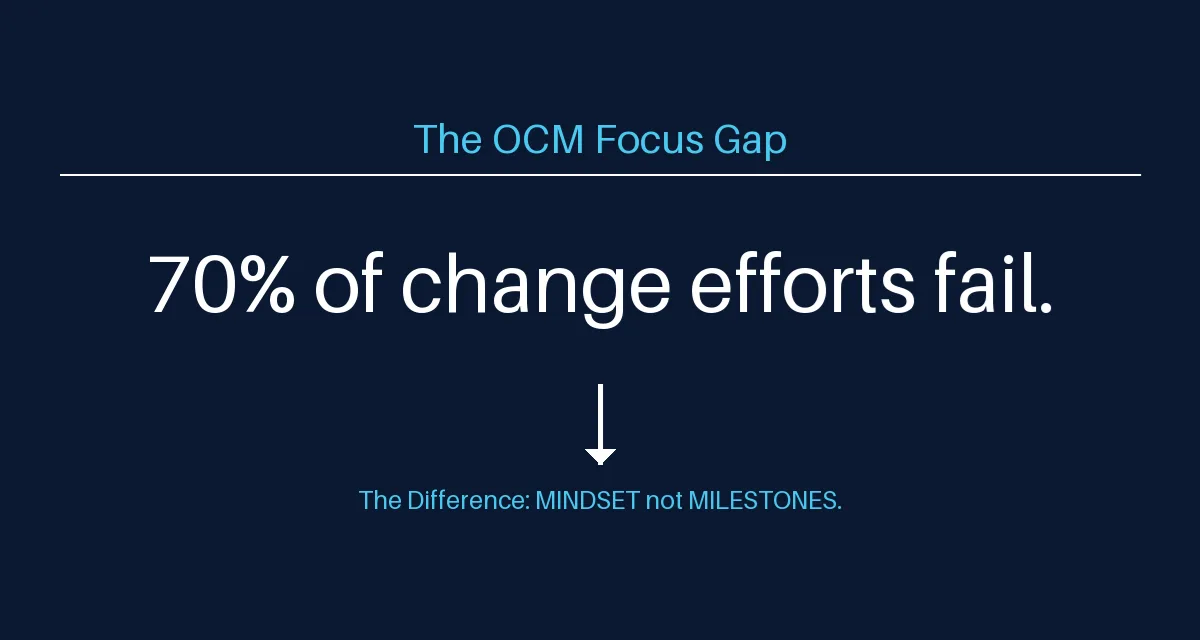
In the next 12 months, organizations will allocate billions to "manage change," yet industry studies consistently show that over 70% of change efforts fail to achieve their stated objectives. This failure isn't a problem of process; it's a crisis of perception. Most leaders view Organizational Change Management (OCM) as a project, a checklist item to be executed and closed when a new system is implemented. This approach is fundamentally flawed. When you treat transformation as a temporary intervention, you are guaranteeing resistance, not resilience.
The real difference between momentum and drag comes down to how we frame the challenge and where we place the locus of control. Successful transformation is not about managing change but about building the capability for continuous momentum. It requires a profound shift in leadership language, operational structure, and strategic intent. We must reimagine OCM as a core discipline that unlocks sustained growth, moving from simply guiding people through a transition to fueling the organization's inherent ability to thrive on uncertainty. This article will reveal the traps that ensnare most initiatives and offer a framework to transform OCM into your ultimate competitive advantage.
1. The Failure Traps: Shifting the Locus of Control
A common assumption is that change efforts stall because employees resist the new thing, the system, the structure, the process. This oversimplifies the human element. The real obstacle is the perception of control. The traditional OCM model often operates under the assumption that an external team or consulting group manages the change for the organization. This creates a psychological barrier: the locus of control is perceived as external to the line leaders and teams who must live the change.
When change is "done to" employees, they passively participate. They wait for the management plan to run its course. For instance, in IT transformations, we often see 44% of new system implementation challenges attributed to people-related factors, not technical ones. This is not resistance; it's a lack of ownership. To strengthen the transformation effort, the change process must be visibly and verifiably owned by the managers and leaders who are closest to the work, elevating their accountability and enabling them to lead the shift.
2. The Language Barrier: From Management to Momentum
Language acts as a powerful tone marker, guiding the emotional and intellectual reaction to transformation. The very term, "Change Management," implies a defensive posture, control, constraint, and minimization of impact. In contrast, the most successful organizations use language that drives a forward-looking, generative mindset.
When companies shift their language, the payoff is clear: higher productivity, less rework, and a stronger sense of shared purpose. Leaders must stop talking about mitigating risk and start talking about creating value. The transition from defensive to generative language is fundamental:
- Avoid: "We are mitigating the risks of..."
- Embrace: "We are unlocking new capabilities to drive..."
- Avoid: "We are controlling the impact of..."
- Embrace: "We are building the organizational muscle to elevate..."
3. The Momentum Capability: The 4 Pillars
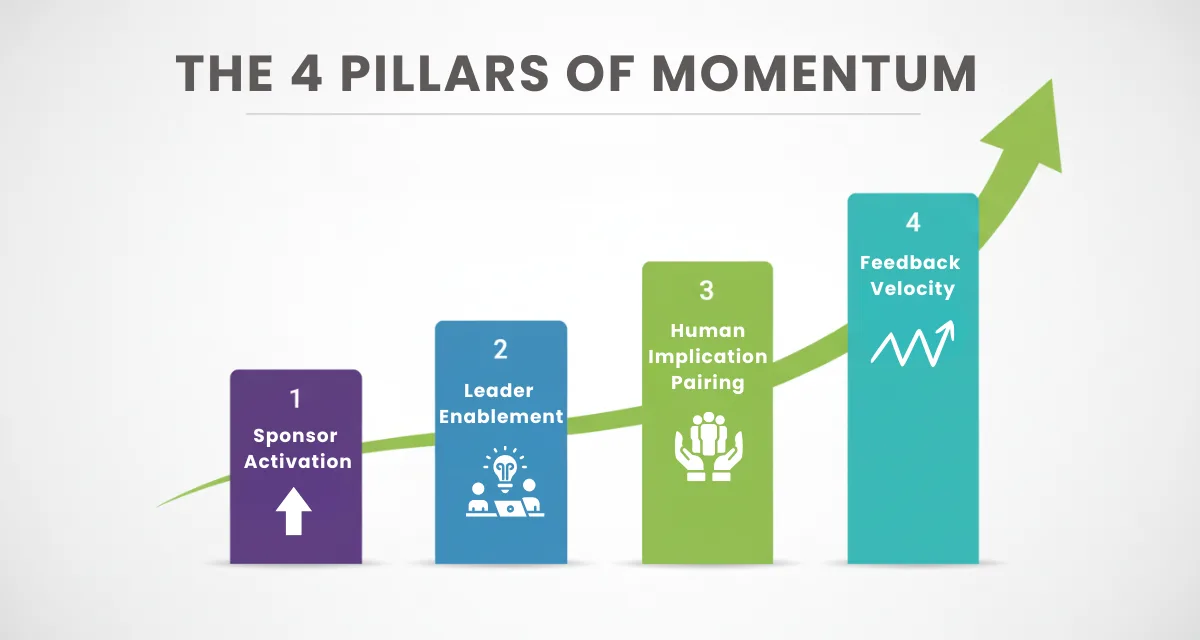
True OCM success is not measured by go-live dates; it is measured by sustained behavioral change and business benefit realization. When organizations move beyond the project mindset, the distinction becomes clear: OCM becomes a system designed to cultivate momentum. This systematic capability rests on four interdependent pillars:
- Sponsor Activation: Moving sponsors from endorsing to actively engaging. They must visibly model the desired future state, making their commitment public and personal.
- Leader Enablement: Equipping mid-level managers with the tools to translate strategy into daily action and local ownership, making them the primary agents of change, not just receivers.
- Human Implication Pairing: Never presenting data in isolation. Every metric of change must be immediately paired with its impact on the human element, ensuring that strategic goals feel personal and relevant.
- Feedback Velocity: Building high-speed, transparent feedback loops that allow the OCM system to adapt and adjust in real time, moving beyond traditional surveys to continuous listening.
4. Operationalizing Authority and Insight
To embed this momentum capability, OCM must be recognized as a source of strategic authority, not just a function of HR or IT. This means integrating the OCM function into the initial strategy development, not merely the implementation phase. Authority is built through evidence and a balanced perspective.
The difference between a change initiative that sticks and one that dissolves comes down to specificity and contextualization. Avoid vague assurances. Instead, use quantitative validation: "The new system is projected to free up 4.5 hours of work hours per week for the finance team by Q3". This level of detail makes the impact tangible and supports an authoritative tone.
Furthermore, our analysis indicates that integrating proprietary research or internal benchmarks positions the company as a thought leader on the subject, not just a follower of best practices. This requires consistent, data-backed communication that is informative without lecturing.
5. Beyond the Project Mindset
Ultimately, reimagining OCM is about accepting that the state of "done" no longer exists. Transformation is not a destination but a continuous state of evolution. The most innovative organizations, the ones that consistently outperform, view change as a design element, a core feature of their operating model, not a bug to be patched.
The modern leader understands that while technology and strategy are important, human skills remain essential for adapting to complex, rapid shifts. This is where the Contrast/Nuance layer becomes vital. While tools can enable greater efficiency, the ability to drive collective action and create shared vision rests entirely on human leadership. Organizations that master the shift from change management to momentum creation are establishing the blueprint for modern leadership.
Conclusion: The Blueprint for Modern Leadership
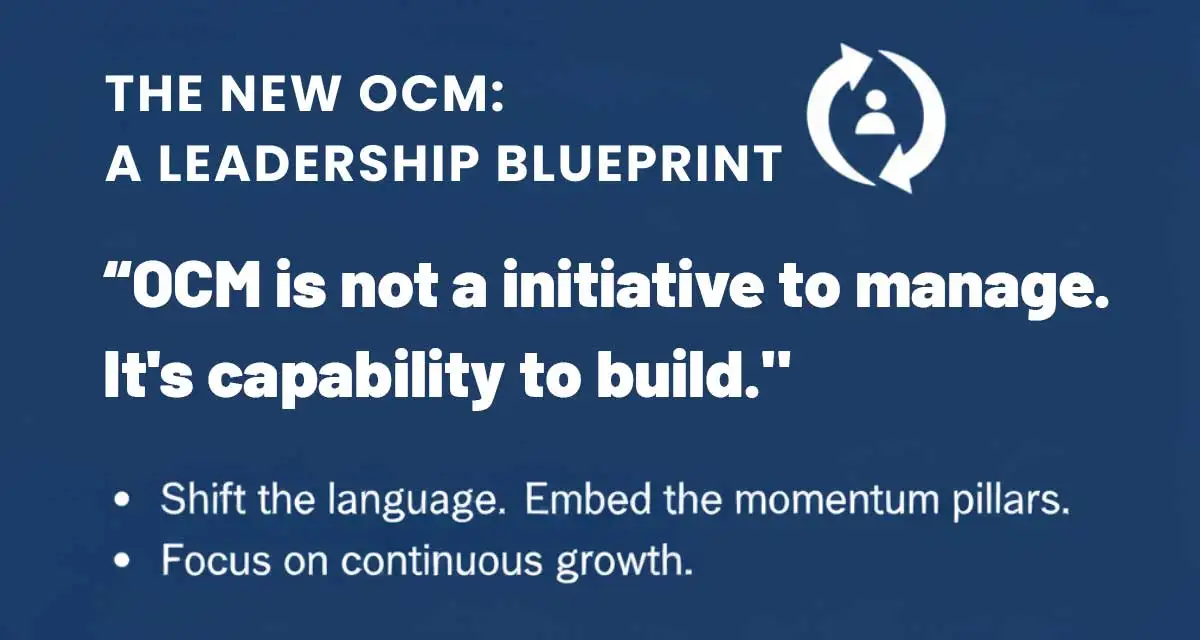
The crisis of the 70% failure rate is not a curse but a clear signal: the traditional model of OCM is obsolete. True, lasting change requires a strategic, systemic approach that transforms OCM from a temporary project activity into a continuous, embedded leadership capability. It demands that we use language to fuel shared ownership, explore new possibilities, and build momentum from the middle out. This is the only way to navigate the constant transitions of the modern economy.
The ability to consistently deliver transformation is now the clearest measure of strategic leadership. Ready to gain the skills that create continuous momentum within your organization? Explore how organizations can apply this shift and build the capability that ensures every investment in change yields its full intended return.
👉 Partner with Ensconce to transform your organization's change capability, build leadership momentum, and create sustainable transformation success. Get a free consultation today.