
Key Metrics That Drive Operational Excellence: A Strategic Guide
In today's hyper-competitive global market, achieving and sustaining Operational Excellence (OpEx) is the mandate for growth. Yet, for many organizations, the pursuit of OpEx becomes mired in the collection of excessive data, leading to confusion instead of clarity. The real strategic advantage is found not in data volume, but in the precision of the metrics used to guide operations.
For Ensconce and our clients, the core principle is simple: identify KPIs that are directly aligned with strategic goals. If your business objective is market leadership through premium quality, your operational excellence metrics must heavily favor quality control and defect prevention. A failure to link your operational measurements to your broader strategy means your teams are optimizing processes that may not matter to the bottom line. The critical shift is from passive reporting to proactive, informed action.
A truly resilient operation demands a balanced scorecard. Focusing exclusively on one area, such as cost will inevitably erode another, like quality. Therefore, world-class organizations monitor productivity, quality, and cost efficiency simultaneously.
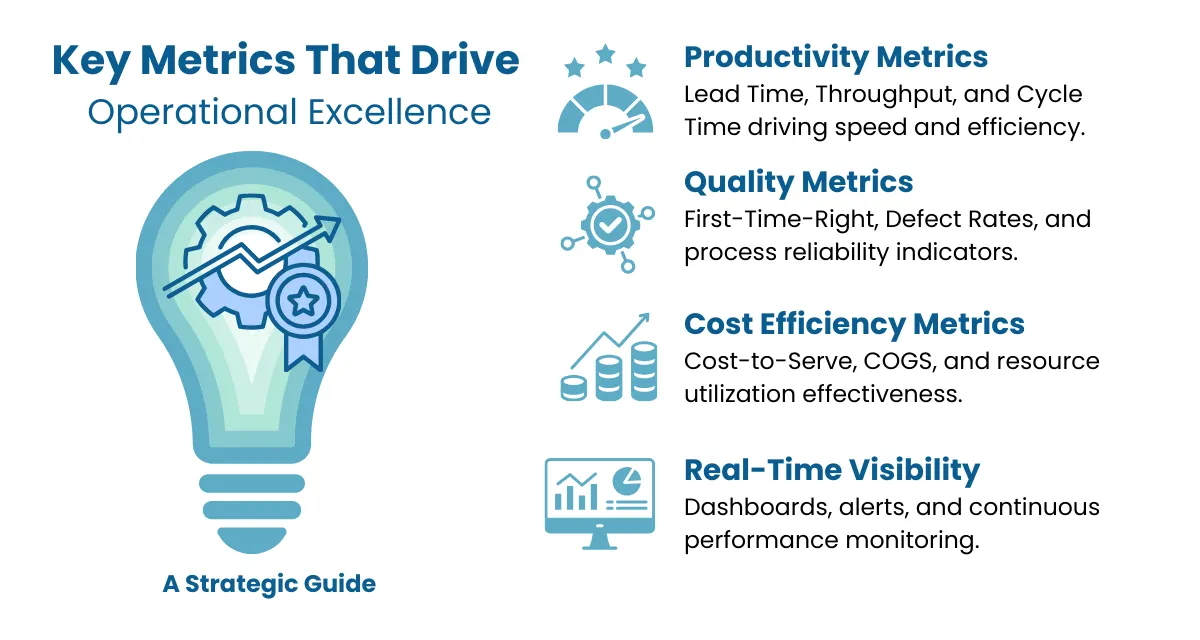
- Productivity Metrics: These measure output velocity. Key examples include Lead Time (the duration from order placement to delivery) and Throughput (the volume of units processed in a specific time frame). A sharp focus on productivity ensures that metrics guide process improvement initiatives aimed at reducing bottlenecks and cycle time.
- Quality Metrics: These quantify process reliability and customer satisfaction. The First-Time-Right (FTR) rate—the percentage of tasks completed correctly without rework—and Defect Density are essential indicators. High FTR suggests process robustness and dramatically lowers the Cost-to-Serve.
- Cost Efficiency Metrics: These tie operational actions to financial health. Tracking the Cost-of-Goods-Sold (COGS), Cost-to-Serve, and Resource Utilization rates provides the necessary financial accountability, ensuring speed and quality are achieved economically.
By establishing a focused set of operational excellence metrics across these three pillars, you build a sustainable framework for improvement.
Actionable Intelligence: Driving Real-Time Intervention
Metrics are only as valuable as their ability to trigger timely decisions. This demands a radical shift from static reporting to dynamic visibility.
To enable speed, you must use dashboards for real-time performance visibility. Modern dashboards provide a cross-functional view of critical KPIs, allowing managers to see deviations as they happen, not weeks later. This immediacy is key: continuous tracking ensures timely interventions. When a critical metric shifts, the system should immediately flag it, allowing teams to diagnose the root cause and course-correct before a minor variance becomes a costly failure.
Crucially, organizations must avoid overcomplicating metrics, focus on actionable data. The most powerful metrics are those that a specific team can influence and understand. If a KPI is too complex or abstract, it will not drive behavior change. Sophisticated analytics enable informed decision-making by providing diagnostic context, turning raw performance data into a roadmap for change. Furthermore, benchmarking highlights areas for improvement by rigorously comparing your operational metrics against industry best practices, identifying tangible gaps to close.
The Cultural Engine of Excellence
No metric system, however perfectly designed, can succeed without the right organizational culture. The metrics themselves are inert; it is leadership's commitment that brings them to life.
Leadership commitment drives a metric-driven culture. Leaders must communicate that performance data is a tool for learning and support, not a weapon for assigning blame. This empowers teams to openly surface issues and take ownership of process improvements.
The final discipline is review. Regular reviews keep operations aligned with strategy and ensure sustained performance. These meetings must be forward-looking and analytical, asking: "What specific process step should we adjust based on this data?" This transforms the review process from a check-the-box exercise into the primary engine of continuous improvement.
Conclusion
True Operational Excellence is the result of shifting your focus from the volume of data to the quality of action it inspires. By aligning your strategic goals with a balanced set of operational excellence metrics and committing to a culture of continuous, data-driven learning, you can ensure your operational performance is predictable, resilient, and competitive. The time to stop measuring busywork and start measuring breakthroughs is now.
Ensconce helps organizations integrate these strategic metrics, building the systems and cultural foundation required to transition from simply running operations to confidently leading your industry.
Ready to transform your operations with the right metrics? Contact Ensconce today to build your path to operational excellence.